Press release: German Society for Planetary Research founded - a new milestone for the exploration of our solar system and beyond
It is with great pleasure that we announce the founding of the German Society for Planetary Research (DGP) on 15 May 2025 in Münster. Its aim is to
- to make activities in the field of planetary research more visible,
- to promote scientific exchange
- and to strengthen cooperation between researchers, institutions and companies.
The society particularly cares about supporting young researchers in order to promote the next generation of scientists and engineers.
In addition to organising scientific events and conferences, the society will intensify the dialogue with politics, industry, research institutions and the public. The aim is to raise public awareness of planetary research on planets in the solar system and extrasolar planets, on moons, comets and asteroids and to make the scientific results accessible to a broad public. Planetary research is a fascinating field that investigates the formation and development of these celestial bodies, not least in order to better understand our Earth.
The society's members come from a wide range of disciplines, including planetology, geosciences, astronomy, physics, computer science and aerospace engineering. One of the major research topics is the search for celestial bodies where the conditions for the existence of life existed in the past and perhaps still exist today. This is why disciplines such as chemistry and biology are also playing an increasingly important role in planetary research. Together, these diverse disciplines are driving forward the exploration of our solar system. Planetary research is laying the foundations for future space missions, both for robotic and for human exploration of the moon and, in the future, even our neighbouring planet Mars.
State-of-the-art methods are used, from remote sensing using spaceborne telescopes and cameras, space missions with landing elements, rovers, helicopters and drones to sample return that enables detailed analyses in the laboratory. In addition to large missions, small satellites offer exciting new options for the future. Furthermore, earth-based telescopes are also becoming increasingly powerful. These diverse approaches contribute to a better understanding of the fundamental physical processes of our planetary system. Those insights are also important for the protection and preservation of our home planet.
We are looking forward to an exciting future and to jointly decipher the secrets of our solar system as well as those of other planetary systems!
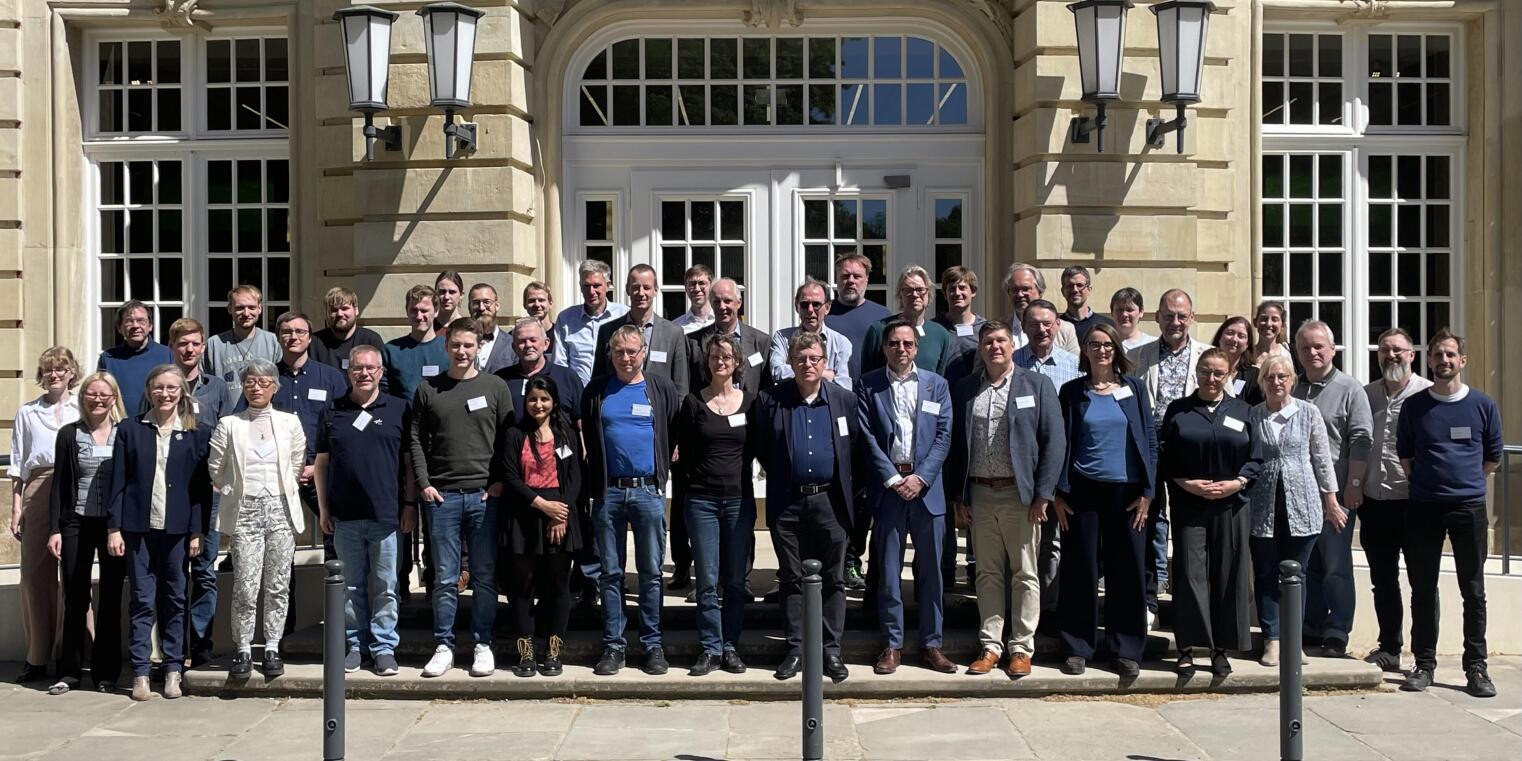
© Uni MS (IfP-Tina-Rückriemen-Bez)